What is Microsoft Dynamics 365?
Microsoft Dynamics 365 is an integrated ERP and CRM platform designed for companies that want a system connected to the Microsoft environment. It is not a monolithic product: it is a suite of modular applications that integrate with each other and with existing Microsoft infrastructure.
Natively covered areas:
- Finance and accounting
- Sales and CRM
- Supply chain and warehouse
- Manufacturing and planning
- Business intelligence with Power BI
In short: Dynamics 365 is the natural choice for those already immersed in the Microsoft ecosystem who want to extend it with ERP functionality — not for those who want to start from scratch with operational flexibility.
What is Odoo?
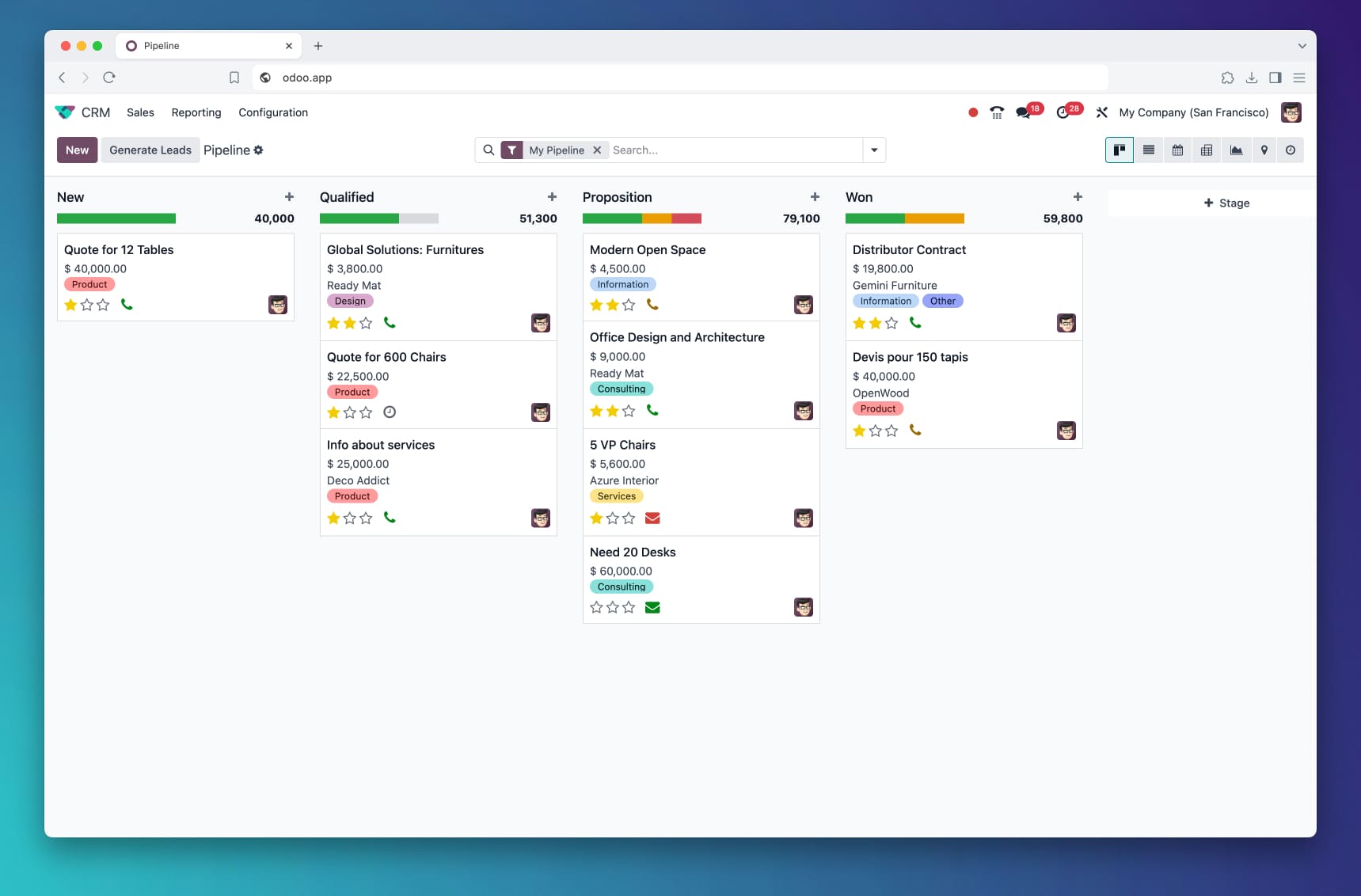
Odoo is a modular open-core ERP that unifies all operational areas of a business in a single platform. Its architecture allows you to activate only the modules needed today and add more in the future, without migrations and without dependence on a proprietary ecosystem.
Main modules:
- Accounting with native Italian tax localisation
- CRM, sales and pipeline management
- Purchasing, warehouse and logistics
- Manufacturing and MRP
- eCommerce, marketing and email marketing
- HR, payroll and project management
In short: Odoo does not require you to already be in any vendor's ecosystem. It activates where needed, grows with the company and natively integrates areas that in Dynamics require additional connectors.
Key differences between Odoo and Microsoft Dynamics 365
01 — Structure and approach
Odoo
Independent modular architecture. Native integration between applications without depending on an external ecosystem.
Microsoft Dynamics 365
Designed to integrate with Office 365, Teams, Azure. Enterprise-oriented logic with strong dependence on the Microsoft ecosystem.
02 — Integration with external ecosystem
Odoo
CRM, sales, marketing and eCommerce natively integrated. No additional connectors required for core operational areas.
Microsoft Dynamics 365
Direct integration with Office 365, Teams, Power BI and Azure. Key strength for those already using this infrastructure.
03 — Costs and growth model
Odoo
Scalable investment. Start with the essential modules and scale up. No lock-in on Microsoft plans.
Microsoft Dynamics 365
Variable costs tied to active Microsoft plans. Can grow quickly with additional licences and specialised ERP modules.
04 — Flexibility and customisation
Odoo
High adaptability to the SME's specific processes. Ideal for businesses that don't want to adapt their flows to the software.
Microsoft Dynamics 365
Enterprise-oriented structure. Customisations require specific expertise and longer timelines.
Odoo or Microsoft Dynamics 365: which to choose for an Italian SME?
The right question is not "which is better" but "which fits my context". These two profiles summarise who chooses one and who chooses the other.
Choose Odoo if...
- You don't want to depend on the Microsoft ecosystem
- You need integrated eCommerce and marketing
- Your processes require adaptation, not standardisation
- Your budget needs to grow progressively
- You want a single system for all operational areas
Choose Dynamics 365 if...
- The company is already deeply embedded in the Microsoft ecosystem
- Office 365, Teams and Power BI are central tools
- You have an internal IT team with Microsoft expertise
- Governance requires integration with Azure
- Budget is not the primary constraint
The role of the partner in the implementation
The quality of the partner weighs as much as — often more than — the choice of software. A good ERP implemented poorly generates complexity; an average ERP implemented well generates operational control.
Regardless of the software, a structured partner brings:
Process analysis
Before configuring anything
Consistent configuration
The system adapts to the flows, not the other way round
Operational training
Not PDF manuals, but hands-on training
Post-launch support
Real problems emerge after go-live
When is Odoo a concrete alternative to Microsoft Dynamics?
Odoo is a valid alternative to Dynamics 365 when the SME recognises itself in at least one of these scenarios:
- Ecosystem independence: the company doesn't want to depend on Microsoft plans for licences, updates and recurring costs
- eCommerce integration: the online channel is part of the business model and must communicate natively with the ERP
- Progressive scalability: the company wants to start with the core modules and add functionality as it grows
- Operational flexibility: processes change frequently and require a system that adapts, not one that constrains
The evaluation must start from an analysis of internal processes and growth objectives — not from the name of the software. Book a free audit →
Comparison table for Italian SMEs
| Criterion | Odoo | Microsoft Dynamics 365 | Practical guidance |
|---|---|---|---|
| Approach | Modular ERP with progressively activatable apps. | ERP platform integrated in the Microsoft ecosystem. | Assess how central the Microsoft environment is. |
| Integration | Native between CRM, sales, warehouse, marketing and eCommerce. | Direct with Office 365, Teams, Azure, Power BI. | Analyse tools already in use within the company. |
| Implementation | Gradual rollout by modules — phases by area. | Projects often more structured and articulated. | Define a realistic activation roadmap. |
| Costs | Scalable based on users and modules. | Variable based on Microsoft plans and ERP modules. | Calculate the full project TCO. |
| Flexibility | High customisation and adaptability to processes. | Enterprise-oriented structure, less adaptable. | Assess the level of organisational formalisation. |
Frequently asked questions
The most common questions from IT managers and directors of Italian SMEs.
Often yes — Odoo allows a modular start that reduces the initial investment and does not depend on Microsoft pricing plans. The correct comparison is on the 3-year TCO: licences, implementation, training, maintenance and updates. For SMEs without Microsoft infrastructure, Odoo is typically more efficient.
Dynamics 365 is the natural choice for companies already dependent on the Microsoft ecosystem — not necessarily for more structured companies in general. An SME with complex processes but no Microsoft infrastructure often finds greater flexibility at lower cost in Odoo.
The right question is: how dependent are you on Microsoft? If Office 365, Teams and Azure are central, Dynamics makes sense as a natural extension. If the company is open to an independent system with more flexibility, Odoo is the most rational choice for the majority of Italian SMEs.