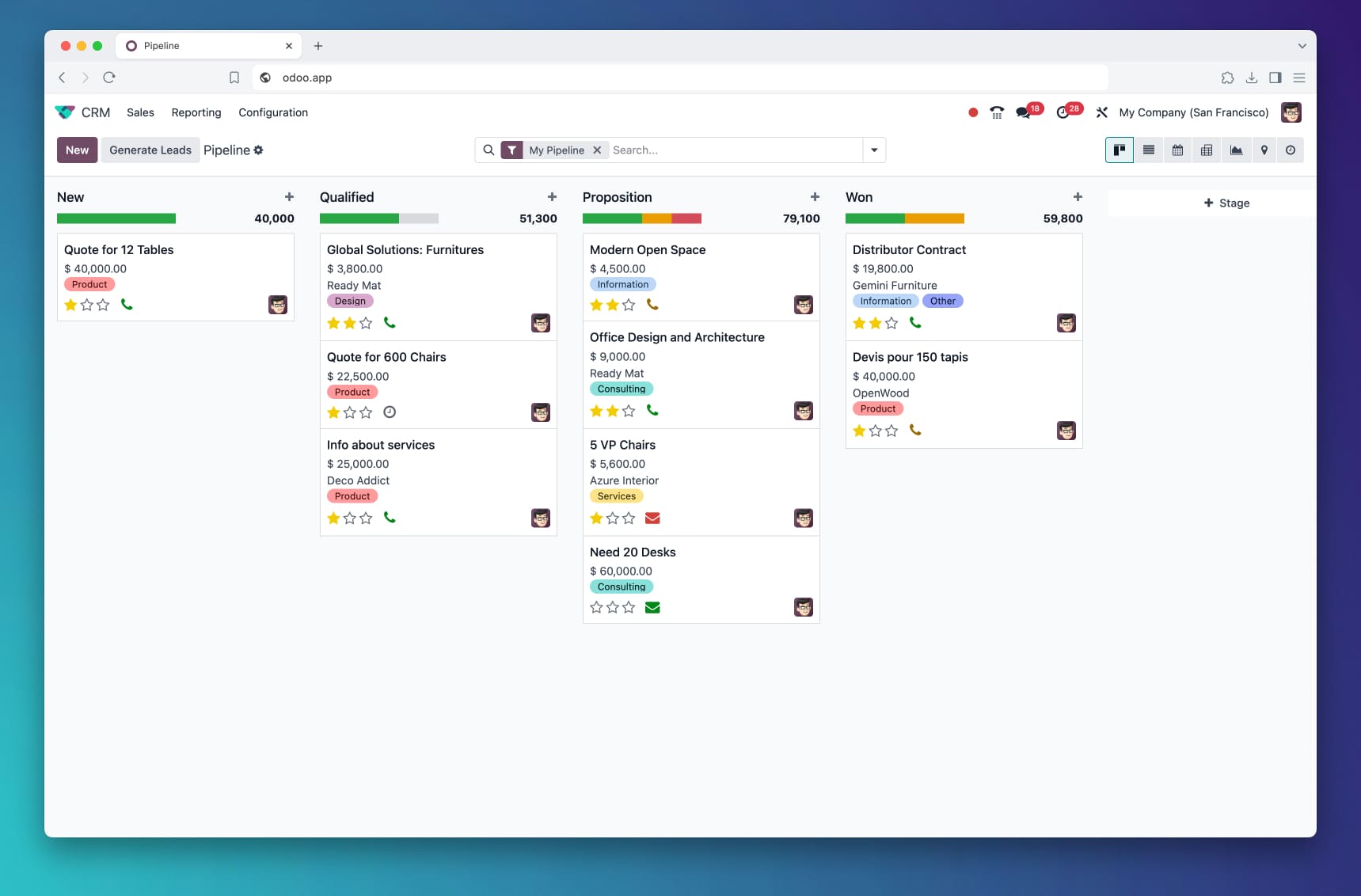
What is an ERP and why is it strategic for an SME?
An ERP (Enterprise Resource Planning) is an integrated management system that connects accounting, sales, warehouse, production and CRM in a single shared platform.
The problem it solves is structural: most Italian SMEs manage these processes with separate software — and pay the hidden cost of fragmentation every day.
With a correctly implemented ERP, an SME gains:
- A single data source — no more double entry or conflicting data between departments
- Fewer operational errors — automated flows eliminate high-risk manual steps
- Real-time reports — visibility on margins, warehouse and cash flow without waiting for month end
- Continuous financial control — accounting is aligned with operations, not separated from them
- Scalability — the system grows with the business without requiring migrations every two years
In short: an ERP is not a software purchase. It is a decision about the operational architecture of your business.
When is the right time to adopt an ERP?
There is no minimum turnover or headcount that determines the right moment. There are, however, precise operational signals that indicate when growth has outpaced the capacity of current tools.
It is time to evaluate an ERP if at least one of the following applies to your business:
- Excel has become the primary system for orders, warehouse or reporting
- Data between the sales office, administration and warehouse is never aligned
- You cannot calculate the real margin per job or per customer in real time
- Electronic invoicing requires manual intervention or generates frequent errors
- Monthly reports arrive too late to guide operational decisions
- Every new employee takes weeks to understand where to find information
If you recognise two or more of these signals, the cost of inaction already exceeds the cost of implementation.
Not sure if the timing is right for your business?
In 30 minutes we analyse your processes and show you where you're losing efficiency — no commitment required.
Book the free auditWhat must an ERP for Italian SMEs include?
The Italian market has specific requirements that many international solutions do not cover natively. Always check these five criteria before evaluating any vendor.
Native Italian tax localisation
VAT management, electronic invoicing with SDI, periodic settlements, reverse charge, expense reports and up-to-date tax templates must be included — not added via third-party modules.
Real modularity
An SME must be able to activate only the modules it needs today and add more in the future. Be wary of systems that require you to purchase the full package to make even a single area work.
Scalability without migrations
The system must handle growth — in users, volumes and processes — without forcing you to migrate to an "enterprise" version after three years.
Integration with the existing ecosystem
eCommerce, marketplaces (Amazon, Alibaba), payment systems, banks, marketing automation tools and logistics platforms must be connectable via standard APIs.
Certified partner with vertical expertise
The software alone implements nothing. The partner who configures, trains and supports the team determines 80% of the project's success. Evaluate them with the same care you give to the software.
The most widely used ERP alternatives for Italian SMEs
These are the most evaluated solutions in the Italian SME segment. None is universally better — the choice depends on company structure, sector and objectives.
Odoo
✓ Key strengthModular open-source ERP with over 50 integrated apps. Suited to SMEs looking for flexibility, scalability and an ecosystem of specialist partners. Native Italian localisation from version 16.
Key strength: value for money and speed of implementation.
SAP Business One
⚠ Evaluate carefully for SMEsEstablished solution for structured companies with complex processes and higher budgets. Strong on manufacturing and international supply chain.
Main limitation: significant licence and implementation costs for SMEs under 50 employees.
Detailed comparison: Odoo vs SAP Business One →Microsoft Dynamics 365
⚠ Depends on the ecosystemPlatform integrated with the Microsoft ecosystem (Teams, Office, Azure). Suited to companies already heavily dependent on Microsoft infrastructure.
To consider: configuration complexity and recurring costs.
Detailed comparison: Odoo vs Microsoft Dynamics 365 →TeamSystem
→ Accounting nicheManagement software widely used in Italy, with a strong foothold in accounting, payroll and tax compliance. Ideal for professional firms and companies with a primary focus on administration.
Limitation: less flexibility on non-accounting operational processes.
Cloud or on-premise ERP: which to choose in 2026?
The question is less relevant than it might seem: in 2026 over 70% of new ERP implementations for SMEs take place in the cloud. The reason is economic before it is technological.
Cloud ERP — when it makes sense
- No server to manage — zero infrastructure costs
- Automatic updates always included
- Access from any device
- Backup and security managed by the vendor
- Predictable cost with a monthly subscription
On-premise ERP — when it makes sense
- Sectors with regulatory requirements on data residency
- Consolidated internal IT infrastructure with a dedicated team
- Environments with unstable connectivity in production
For most Italian SMEs, the cloud is today the most rational choice — not just for costs, but for implementation speed and reduced operational risk.
The ERP partner matters more than the software
This is the truth vendors have no interest in telling you: 60–70% of ERP projects that fail do not fail because of software limitations — they fail because of partner limitations or the implementation approach.
A structured partner brings to the project:
Process analysis
Before configuring anything
Consistent configuration
The system adapts to your flows
Operational training
Not PDF manuals, hands-on training
Post-launch support
Real problems emerge after go-live
Continuous evolution
The system grows with the business over time
When evaluating a partner, ask for references from companies similar to yours in sector and size. A partner with 50 implementations in your sector is worth more than one with 500 generic implementations.
Want to evaluate Koratyn as a partner for your implementation?
We share concrete references in your sector — before any commercial proposal.
Talk to us Find out who we areHow to choose the best ERP for your business: the practical process
An effective choice follows a structured six-phase process. Skipping a phase increases the risk of choosing wrong — or of successfully implementing the wrong software.
Map existing processes
Document how you work today, not how you would like to work. The ERP is configured around the current operational reality.
Define measurable objectives
Fewer invoicing errors, real-time warehouse visibility, accounting close within 5 days. Vague objectives produce vague implementations.
Evaluate alternatives on objective criteria
Tax localisation, modularity, scalability, total project cost (not just the licence).
Verify Italian tax localisation
Ask for a specific demo on electronic invoicing, SDI and VAT settlements. Do not trust commercial claims.
Calculate the 3-year TCO
Licence + implementation + training + maintenance + updates. The apparently cheapest system often isn't.
Select the partner before the software
A good partner will help you choose the right solution, even if it is not the one they primarily sell.
Frequently asked questions
The most common questions from IT and administrative managers at Italian SMEs.
There is no universal answer. The best ERP is the one that integrates your specific processes, complies with Italian tax regulations and is implemented by a partner with experience in your sector. Odoo is often the most balanced choice for flexibility and total project cost.
The cost varies significantly based on number of users, modules activated and process complexity. For an Italian SME with 10–30 users, a full Odoo project typically sits between €15,000 and €60,000 in implementation costs, plus the annual licence fee. The 3-year TCO is the most significant figure to compare across different solutions.
For an SME with standard processes (sales, purchasing, warehouse, accounting), an Odoo implementation typically takes 3–6 months. The main variable is the complexity of existing processes and the availability of the internal team during the project.
Enterprise cloud solutions guarantee security standards that exceed those of a server managed internally by an SME: multiple automatic backups, data encryption, 24/7 monitoring and GDPR compliance.
For most Italian SMEs under 100 employees, Odoo offers a better value for money and greater implementation flexibility. SAP Business One makes sense for very complex manufacturing processes or international supply chains with specific compliance requirements.