What is SAP Business One?
SAP Business One is an ERP designed for small and medium-sized businesses that need a structured and consolidated system. It is an enterprise-grade platform with a rigid setup and processes defined upfront, often adopted by companies with an already-formalised organisational structure.
Natively covered areas:
- Accounting and advanced financial management
- Warehouse and purchasing management
- Manufacturing and planning
- Reporting and business intelligence
- CRM and sales management
In short: SAP Business One works best when business processes are already defined and the aim is a system that formalises them — not one that adapts to them.
What is Odoo?
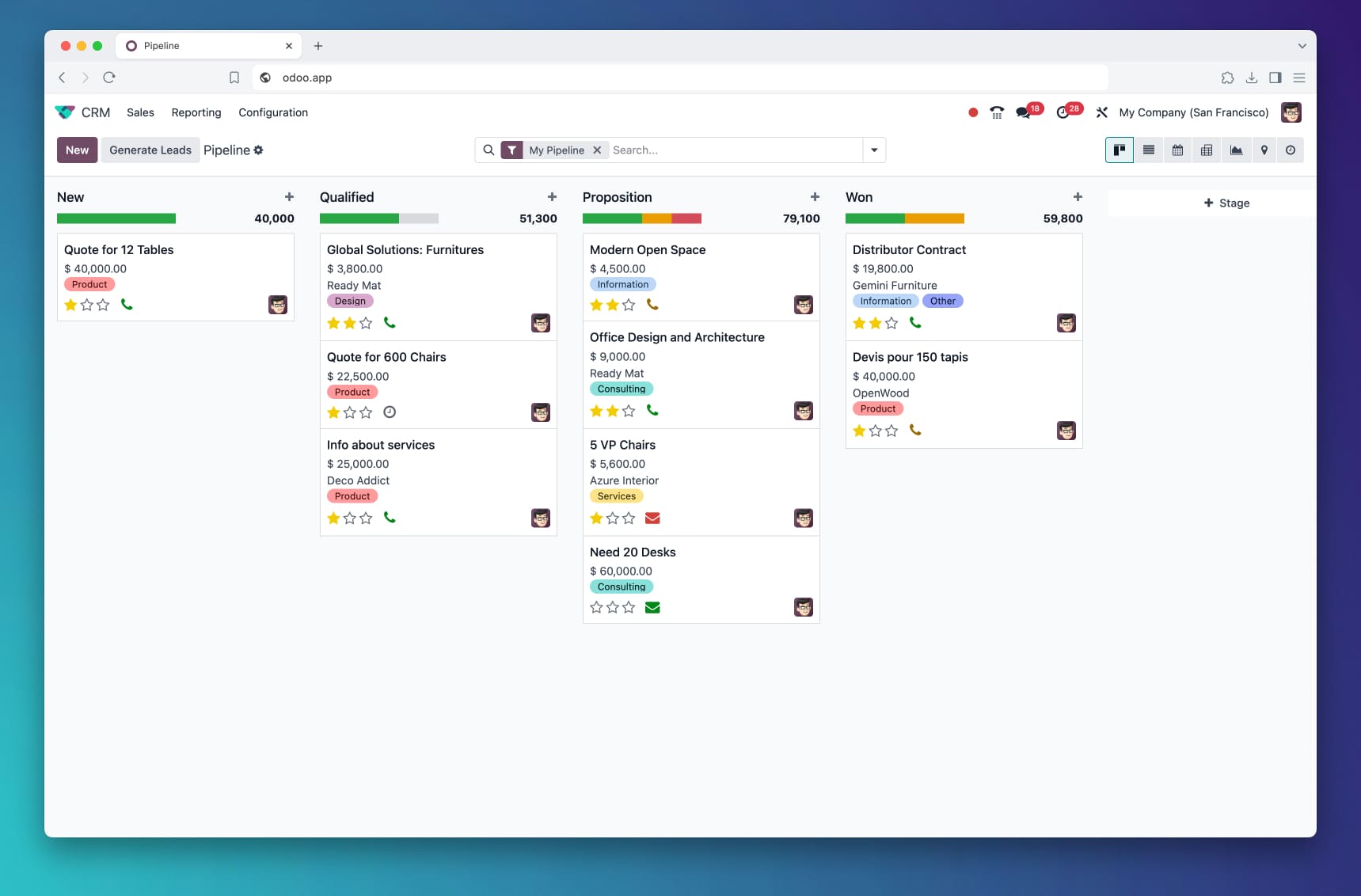
Odoo is a modular open-core ERP that unifies all operational areas of a business in a single platform. Its architecture allows you to activate only the modules needed today and add more in the future, without migrations.
Main modules:
- Accounting with native Italian tax localisation
- CRM, sales and pipeline management
- Purchasing, warehouse and logistics
- Manufacturing and MRP
- eCommerce, marketing and email marketing
- HR, payroll and project management
In short: Odoo is the choice for those who want a system that grows with the company — activating modules progressively, without paying upfront for functionality not yet needed.
Key differences between Odoo and SAP Business One
01 — System structure
Odoo
Progressively activatable modules. Adapts to the company's processes, not the other way round.
SAP Business One
Rigid and structured setup. Customisations are often complex and costly.
02 — Costs
Odoo
Scalable investment. Start with the essential modules and scale up. TCO often lower for SMEs under 100 users.
SAP Business One
Higher licences, specialist consulting required. Significant initial investment even for standard configurations.
03 — Implementation
Odoo
Progressive rollout by module. Faster go-live on priority areas, with subsequent extension.
SAP Business One
Typically "big bang" projects. Longer timelines in complex contexts or with non-standardised processes.
04 — Flexibility
Odoo
High adaptability. Ideal for dynamic organisations that evolve over time and require tailored configurations.
SAP Business One
Structural rigidity as a strength for those with already-formalised processes that must not be changed.
Odoo or SAP Business One: which to choose for an Italian SME?
The answer depends on three variables: organisational structure, available budget and required level of customisation. These two profiles summarise the typical characteristics of those who choose one or the other.
Choose Odoo if...
- You want modularity and progressive growth
- You need native eCommerce integration
- The budget requires gradual scalability
- Processes are still evolving
- You want a predictable TCO over time
Choose SAP B1 if...
- Processes are already formalised and rigid
- You operate in complex manufacturing or international supply chains
- You have a dedicated internal IT team
- Budget is not the primary constraint
- Governance requires consolidated enterprise standards
The role of the partner in the implementation
This is the variable vendors have no interest in communicating: 60–70% of ERP projects that fail do not fail because of software limitations, but because of partner limitations or the implementation approach.
Regardless of the software chosen, a structured partner brings to the project:
Process analysis
Before configuring anything
Consistent configuration
The system adapts to the flows, not the other way round
Operational training
Not PDF manuals, but hands-on training
Post-launch support
Real problems emerge after go-live
When is Odoo a concrete alternative to SAP for an SME?
Odoo is a valid alternative to SAP Business One when the SME recognises itself in at least one of these scenarios:
- Operational flexibility: processes change frequently and the system must adapt, not constrain
- Progressive scalability: the investment must grow with the company, not be borne entirely upfront
- Native integration: eCommerce, marketing automation and CRM must talk to the ERP without additional connectors
- Time-to-value: the company wants an operational system within a reasonable timeframe, not a multi-year project
The evaluation must always start from an analysis of internal processes — not from the name of the software. Book a free process audit →
Comparison table for Italian SMEs
| Criterion | Odoo | SAP Business One | Practical guidance |
|---|---|---|---|
| Approach | Modular ERP with progressively activatable apps. | Structured ERP with consolidated processes and standardised setup. | Modularity is useful when growth happens step by step. |
| Typical target | SMEs seeking inter-departmental integration and evolutionary flexibility. | Structured SMEs with already-formalised governance. | Align the choice with the level of organisational maturity. |
| Implementation | Gradual rollout by area — sales, warehouse, accounting in phases. | "Big bang" projects with heavier configurations from the outset. | Define a roadmap by modules and operational priorities. |
| Customisation | High adaptability through configurations and targeted development. | Customisations managed with structured project approaches. | Assess impact on timelines, budget and maintenance. |
| Integrations | Native between modules + connectors for the external ecosystem. | Via the SAP ecosystem and dedicated solutions. | List essential integrations: eCommerce, WMS, BI, banking. |
| Costs | Scalable based on users and activated modules. | Typically higher investment, demanding licences and project costs. | Use the TCO: licences + project + training + support. |
| Adoption | Operational training by department, modern interface. | Structured training and process governance. | The partner guides adoption. |
Frequently asked questions
The most common questions from IT managers and directors of Italian SMEs.
In many cases yes — Odoo allows a modular start that reduces the initial investment. But the correct comparison is on the 3-year TCO: licences, implementation, training, maintenance and updates. On this horizon, Odoo is often more efficient for SMEs under 100 employees.
It depends on what "powerful" means. SAP B1 is stronger on enterprise governance and international supply chain. Odoo is more complete on native integration between modules, eCommerce and marketing. For the majority of Italian SMEs, Odoo covers 95% of operational needs with less complexity.
There is no universal answer, but a practical criterion: if processes are still evolving and the budget requires gradual scaling, Odoo is the most rational choice. If the company has rigid processes, operates in complex manufacturing and has a dedicated IT team, SAP B1 deserves serious consideration. The partner you choose weighs as much as the software.